Does My HOA Need a Dumpster Rental Permit?
 This common question is slightly more complicated than it sounds.
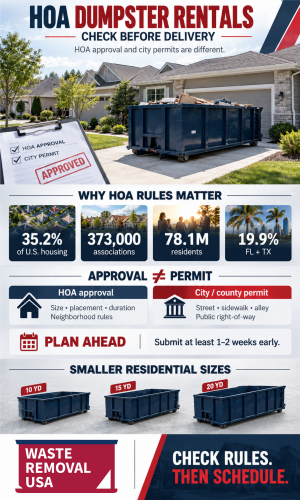
Your HOA generally does not issue the same type of government permit that a city or county might require. Instead, you may need written HOA approval or authorization before placing a temporary dumpster on your property.
That HOA approval is separate from any municipal permit.
For example, you could potentially need:
HOA approval because your community regulates temporary dumpsters, construction equipment, exterior alterations, driveway use, or visible storage containers.
A city or county permit because the dumpster will occupy a public street, sidewalk, alley, parking area, or other public right-of-way.
In some situations, you could need both.
Waste Removal USA’s guide to street permits for dumpster rentals explains why containers placed on public property are more likely to trigger municipal permitting requirements. Local regulations vary, however, so homeowners should always check the current rules where the property is located.
If the dumpster will remain entirely on your private driveway, municipal permitting may be less likely, but that does not automatically exempt the project from HOA rules.
Why HOAs Regulate Temporary Dumpster Rentals
Most HOA dumpster rules are less about the contents of the dumpster than about how the container affects the neighborhood. A large roll-off dumpster can occupy a driveway for several days, remain visible from neighboring homes, interfere with parking, narrow access on a residential street, or become part of a longer construction project. Because of that, HOA rules may address factors such as dumpster placement, container size, rental duration, delivery hours, screening, driveway protection, contractor activity, parking availability, and how quickly the container must be removed after the project ends. The exact language may appear in the community’s declaration, covenants, conditions and restrictions, architectural guidelines, construction rules, community standards, or separate rules and regulations. Do not assume that because you have seen another dumpster in the neighborhood, the same rules apply to your project. That homeowner may have received advance approval, had different placement options, or been working under different construction requirements.How Long Does HOA Dumpster Approval Take?
There is no nationwide standard approval time for an HOA dumpster rental. A property manager might be able to approve a routine temporary-container request relatively quickly. Another association may require review by an architectural committee or board, particularly when the dumpster is connected with remodeling, roofing, exterior work, or another project that already requires association approval. For planning purposes, submitting your request at least one to two weeks before the intended delivery date gives you more room to handle questions or additional paperwork. That is a planning recommendation rather than a universal HOA requirement. If your governing documents specify a review period, follow that timeline instead. Do not wait until the day before delivery if you can avoid it. A dumpster company may have availability for fast delivery, but that does not shorten your HOA’s approval process.What Information Does an HOA Usually Need?
 Providing complete information with the first request can make the approval process easier.
A useful HOA dumpster request should identify the container size, proposed delivery date, expected pickup date, exact placement location, type of project, dumpster rental company, and whether contractors will also be working at the property.
If you have a site photo or simple driveway diagram, including it can remove ambiguity about where the dumpster will be placed.
For homeowners trying to get approval quickly, a practical process is:
- Review your HOA’s CC&Rs, construction rules, architectural guidelines, and community regulations before ordering the dumpster.
- Contact the property manager or HOA office and ask specifically about temporary roll-off containers.
- Determine whether the project itself also requires architectural approval.
- Choose the smallest dumpster size that can reasonably handle the project.
- Submit the requested size, placement location, delivery date, pickup date, and project description in writing.
- Check local government requirements separately if any portion of the container will occupy public property.
- Keep the written approval available until the dumpster has been removed.
How Likely Is an HOA to Approve a Dumpster?
There is no credible national database tracking what percentage of residential dumpster requests HOAs approve, so any universal approval percentage would be misleading. Approval depends primarily on the association’s governing documents and the specifics of your request. Your request is generally easier for an association to evaluate when the dumpster is temporary, positioned completely on your property, does not block sidewalks or traffic, is appropriately sized for the job, has specific delivery and removal dates, and complies with existing construction or renovation rules. A vague request for a large dumpster with no defined removal date is more likely to raise questions. Placement matters as well. Waste Removal USA’s guide to choosing a dumpster placement location discusses access, clearance, neighborhood requirements, and other factors that can affect where a container should sit.What Size Dumpster Will an HOA Allow?
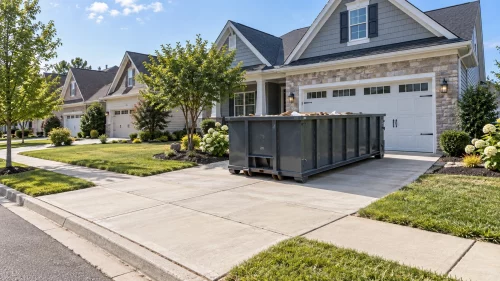 There is no standard “HOA-approved dumpster size.”
One association might allow a 20-yard container in a driveway while another limits temporary containers based on dimensions, height, placement, visibility, or available parking rather than cubic-yard capacity.
That is why homeowners should ask the HOA about physical dimensions as well as dumpster capacity.
Here is how common Waste Removal USA roll-off sizes compare:
| Dumpster Size | Typical Dimensions* | Approximate Capacity | Common Residential Uses |
| 10-yard dumpster | 12–14 ft. long × 7.5–8 ft. wide × 3–3.5 ft. high | About 3 pickup loads | Small cleanouts, single-room projects, limited debris |
| 15-yard dumpster | About 14 ft. long × 8 ft. wide × 4.5 ft. high | About 4.5 pickup loads | Medium cleanouts and smaller remodeling projects |
| 20-yard dumpster | About 20 ft. long × 8 ft. wide × 4 ft. high | About 7 pickup loads | Multi-room renovations, flooring, roofing and larger cleanouts |
| 30-yard dumpster | About 22 ft. long × 8 ft. wide × 6 ft. high | About 9 pickup loads | Major renovations, additions and large cleanouts |
| 40-yard dumpster | About 22 ft. long × 8 ft. wide × 8 ft. high | About 12 pickup loads | Major renovations, estate cleanouts and large-volume projects |
Dumpster Placement Can Matter as Much as Dumpster Size
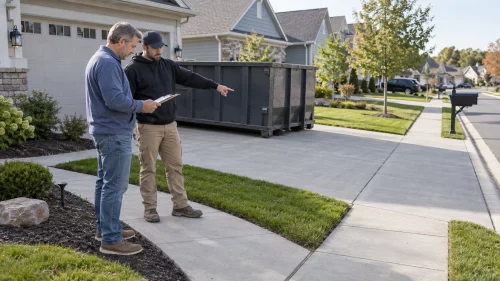 An HOA may care more about where the dumpster sits than the number printed on the side of the container.
A private driveway is often the most straightforward option because it keeps the dumpster off public streets and common property. However, you still need enough room for the container itself and for the delivery truck to safely place and retrieve it.
Consider garage access, neighboring driveways, sidewalks, mailboxes, fire hydrants, gates, landscaping, irrigation systems, overhead branches and utility lines before selecting the location.
You may also want to protect the pavement beneath the container. Waste Removal USA has additional guidance on reducing the risk of driveway damage when renting a dumpster.
Never place a dumpster on HOA-owned common property without specific authorization.