What Should You Do With an Old Lawn Mower?
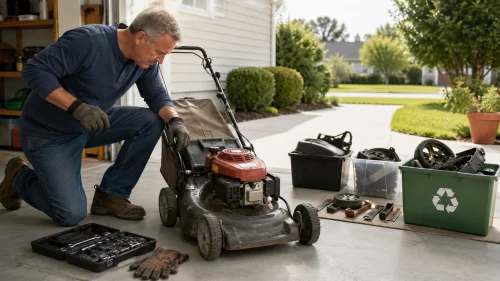 The best option depends on whether the mower is still usable.
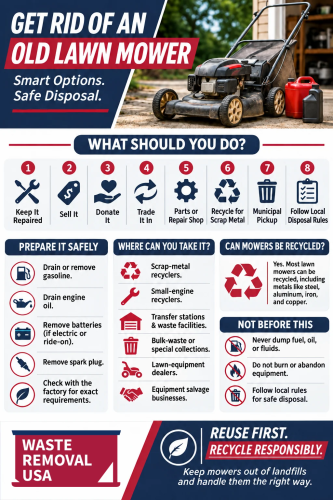
Start with these possibilities in order:
- Keep using it if a reasonable repair will restore it.
- Sell it if it still runs or has value as repairable equipment.
- Donate it if an organization agrees to accept it.
- Trade it in when a mower dealer or manufacturer offers a program.
- Sell or give it to someone who repairs lawn equipment.
- Take it to an approved scrap-metal or equipment recycler.
- Use a municipal bulky-item or special collection program if one accepts lawn equipment.
- Follow local disposal instructions if recycling is not available.
How Do You Get Rid of a Lawn Mower That Still Works?
A functioning mower normally has more value as equipment than as scrap metal. Depending on its age and condition, consider:- Selling it locally
- Donating it
- Giving it to a family member or neighbor
- Trading it in
- Offering it to a small-engine repair shop
- Selling it as a used lawn-care machine
- Whether it starts
- Whether it moves under its own power
- Whether the blade engages
- Known engine problems
- Battery condition
- Missing safety guards
- Tire condition
- Recent repairs
Can You Donate an Old Lawn Mower?
Possibly, but donation organizations decide what equipment they will accept. A working push mower, riding mower, or electric mower may be useful to a nonprofit, community garden, church, school program, tool library, or other local organization. Call first. Some donation centers do not accept gasoline-powered equipment because of storage, transportation, fuel, maintenance, or liability concerns. Before donating, ask whether the organization accepts:- Gas push mowers
- Riding mowers
- Corded electric mowers
- Battery-powered mowers
- Equipment needing minor repairs
- Mowers with batteries
- Equipment containing fuel
Can You Sell a Broken Lawn Mower?
Yes. A broken mower may still have value to mechanics, equipment rebuilders, and people searching for parts. Useful components can include:- Engines
- Starters
- Wheels
- Decks
- Transmissions
- Carburetors
- Controls
- Handles
- Spindles
- Seats
- Electrical components
- Batteries that remain serviceable
Where Can You Take Junk Lawn Mowers?
 Where to take junk lawn mowers depends on local programs and the mower’s condition.
Possible destinations include:
- Scrap-metal recyclers
- Small-engine recyclers
- Municipal transfer stations
- Household waste facilities
- Bulky-item collection programs
- Special recycling events
- Lawn-equipment dealers
- Equipment salvage businesses
- Do you accept lawn mowers?
- Do you accept riding mowers?
- Must gasoline be removed?
- Must oil be removed?
- Do you accept the engine intact?
- Must batteries be removed?
- Are tires accepted?
- Is there a fee?
- Do I need identification or proof of residency?
- Do you offer pickup?
Can Lawn Mowers Be Recycled as Scrap Metal?
Many lawn mowers contain substantial amounts of recyclable metal. A typical gas mower can contain steel, aluminum, iron, copper, and other recoverable materials. Riding mowers contain even more metal because of their larger frames, decks, engines, transmissions, and other components. However, the entire machine does not necessarily belong in a standard scrap-metal pile. The recycler may require preparation involving:- Fuel
- Engine oil
- Battery
- Tires
- Plastic
- Grass catcher
- Other nonmetal components
Do You Have to Drain Gas Before Lawn Mower Disposal?
Not necessarily before every disposal method. Ask the facility accepting the mower first. Many recyclers require gasoline-powered equipment to arrive without fuel. Other facilities may have their own procedures for handling equipment that still contains fuel. If gasoline must be removed, follow the mower manufacturer’s instructions and use an approved gasoline container. Never pour unwanted gasoline:- On the ground
- Into a sink
- Into a toilet
- Into a storm drain
- Into a street drain
What Should You Do With Oil From an Old Lawn Mower?
Used mower oil should be collected and recycled or handled through an approved local program. EPA notes that oil from lawn mowers can contaminate soil and water when improperly managed and recommends recycling used oil whenever possible. See the EPA’s used oil recycling guidance for consumer information. If the receiving mower recycler requires the engine oil removed:- Follow the mower manufacturer’s procedure.
- Use an appropriate drain pan.
- Transfer the oil into a secure container.
- Keep it separate from gasoline and other chemicals.
- Take it to an approved used-oil collection location.
How Do You Get Rid of a Battery-Powered Lawn Mower?
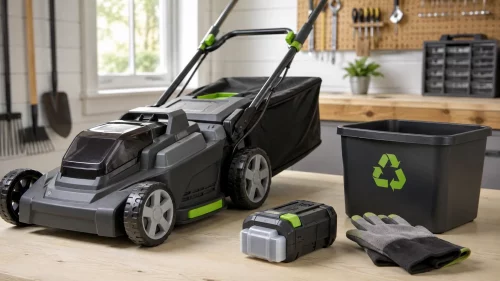 Battery-powered mowers require a different disposal plan from gasoline mowers.
The mower itself may contain recyclable metal, plastic, motors, wiring, and electronic components. The rechargeable battery requires separate attention.
Many modern cordless lawn mowers use lithium-ion batteries.
EPA advises that lithium-ion batteries should not go into household garbage or curbside recycling bins because damaged or crushed batteries can cause fires.
Instead, batteries should be taken to an appropriate battery recycling location or household hazardous waste collection point.
Review the EPA’s used household battery guidance before disposing of mower batteries.
Should You Remove the Lithium-Ion Battery From an Electric Mower?
Remove a battery only when it is designed to be removable and doing so can be accomplished safely according to the manufacturer’s instructions. Many cordless mower batteries are designed to slide out for charging and can be separated easily. If the battery is removed for recycling, EPA recommends protecting the terminals from contact with metal. Appropriate nonconductive tape can be placed over exposed terminals, or individual batteries can be bagged separately where required by the collection program. Do not:- Crush the battery
- Puncture it
- Open the casing
- Disassemble battery cells
- Put it in household recycling
- Put it in household garbage
- Leave terminals where they can short against metal
What Do You Do With a Riding Mower Battery?
Gas-powered riding mowers frequently use lead-acid batteries. These should also be handled separately rather than placed in ordinary household garbage or curbside recycling. EPA recommends returning lead-acid batteries to a battery retailer or household hazardous waste collection program. If you are removing the battery yourself, follow the equipment manufacturer’s instructions. Avoid shorting terminals with tools or allowing the battery to tip or leak. If the case is cracked, leaking, swollen, or otherwise damaged, contact the receiving facility before transporting it.How Do You Get Rid of an Old Riding Mower?
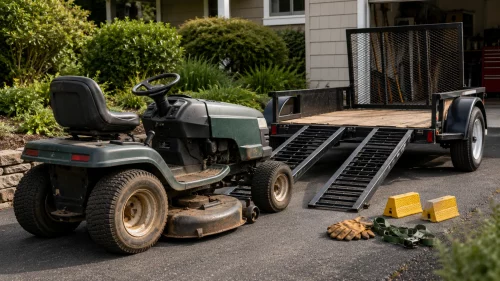 Knowing how to get rid of an old riding mower requires more planning because the equipment is substantially heavier than a push mower.
A riding mower can weigh several hundred pounds and may contain:
- Gasoline
- Engine oil
- Lead-acid battery
- Steel frame
- Cutting deck
- Tires
- Transmission
- Hydraulic components on some models
What If the Riding Mower Does Not Roll or Drive?
A disabled riding mower can be difficult to move because the transmission, brakes, seized wheels, or flat tires may prevent normal loading. Before forcing it:- Read the owner’s manual for the transmission release procedure.
- Confirm whether the parking brake can be released.
- Check whether tires will hold enough air for movement.
- Make sure the steering system functions.
- Determine the mower’s approximate weight.
What Should You Do With an Old Push Mower?
What to do with an old push mower depends primarily on whether it has a gasoline engine, an electrical cord, or a rechargeable battery. For a gas push mower:- Determine whether it can be reused.
- Choose a recycler or approved receiving facility.
- Ask about fuel and oil requirements.
- Prepare it according to those rules.
- Transport it securely.
Should You Remove the Lawn Mower Blade Before Recycling?
Usually, not unless the receiving facility tells you to. Removing a blade can expose you to sharp edges, rusted fasteners, stored mechanical tension, and difficult hardware. If the recycler accepts the mower intact, there is little reason to disassemble it unnecessarily. If blade removal is required, follow the mower manufacturer’s service instructions and disconnect the machine from its energy source first. That may involve removing a spark-plug connection or battery according to the equipment instructions. Wear suitable gloves and handle the blade as a sharp object even when it appears dull. Do not repurpose mower blades into homemade knives or other cutting tools. Lawn mower blades are engineered for mower operation, can contain hidden cracks or damage, and are better handled through appropriate reuse or metal recycling.Can You Put an Old Lawn Mower Out With Regular Trash?
Do not assume you can. Local rules vary significantly. Some municipal programs may accept fully prepared lawn mowers during bulky-item collection. Others prohibit small engines, batteries, fuel-containing equipment, or scrap metal from regular curbside service. Before placing a mower at the curb, contact the local waste authority. A mower containing gasoline, oil, or a rechargeable battery may require special preparation even when the municipality accepts the equipment itself. Never hide prohibited materials inside ordinary household waste.Can You Put a Lawn Mower in Curbside Recycling?
Generally, no. A complete mower does not belong in a standard household recycling cart intended for cans, bottles, paper, cardboard, and other common recyclables. Metal recycling facilities use different equipment and processes. Lithium-ion mower batteries are especially important to keep out of curbside recycling. EPA warns that they can become damaged during collection and processing and start fires. Use a dedicated equipment, scrap-metal, electronics, battery, or household hazardous waste program instead.What If the Mower Contains Old Gas That Has Been Sitting for Years?
Treat old gasoline carefully. Do not assume it can safely be added to a vehicle or another engine, especially if it has been contaminated with water, dirt, oil, or other substances. Keep the gasoline in an appropriate approved container and ask the local household hazardous waste program how it should be managed. Never intentionally evaporate gasoline as a disposal method. Keep gasoline away from:- Flames
- Cigarettes
- Sparks
- Heaters
- Electrical equipment that can ignite vapors
- Children
- Pets
Can You Trade In an Old Lawn Mower?
Sometimes. Lawn-equipment dealers, manufacturers, and retailers occasionally offer trade-in or recycling programs, particularly when you purchase replacement equipment. Programs can be seasonal and location-specific. Call the dealer and ask whether they:- Accept the brand you own
- Require the mower to run
- Accept riding mowers
- Accept electric mowers
- Accept batteries
- Provide store credit
- Have fuel-preparation requirements
- Offer pickup
Can You Give Away a Broken Mower for Parts?
Yes, if someone knowingly wants it as a repair project or parts machine. Provide an accurate description. Useful information includes:- Brand and model
- Approximate age
- Engine model
- Cutting width
- Known problems
- Missing parts
- Battery condition
- Whether the engine turns
- Whether the transmission works
- Whether the deck is rusted through
Is Lawn Mower Recycling Free?
Sometimes, but not always. Scrap-metal value may allow some recyclers to accept prepared mowers without a disposal fee. Municipal programs may offer periodic free collection to residents. Other locations charge a fee for equipment, tires, fluids, batteries, or difficult-to-process components. A riding mower may have more scrap value but can also be harder to transport. Ask about all fees before you make the trip. Also ask whether the facility pays for scrap metal. Policies change with local markets and facility rules.What Is the Most Eco-Friendly Lawn Mower Disposal Method?
The most environmentally responsible option generally follows the waste hierarchy:- Reuse first. Keep the mower working if a reasonable repair makes sense.
- Sell or donate next. Extending equipment life avoids replacing it prematurely.
- Salvage usable parts. Repair businesses or individual mechanics may be able to reuse engines, wheels, decks, and other components.
- Recycle remaining materials. Metal and batteries can often enter specialized recycling streams.
- Dispose only when necessary. Follow local requirements for materials that cannot be reused or recycled.
How Do You Prepare a Lawn Mower for Transportation?
Preparation depends on the destination, so confirm its rules first. Then:- Allow hot equipment to cool completely.
- Follow facility instructions for fuel and oil.
- Remove a battery only if required and safe to do so.
- Secure loose grass catchers or attachments.
- Lower or stabilize adjustable components.
- Prevent the mower from rolling during transport.
- Keep fluid containers upright and separate.
- Use appropriate loading equipment.
How Should You Handle a Lawn Mower During a Larger Yard Cleanup?
A mower is only one item that may surface during a larger garage, shed, or yard cleanup. You may also have:- Broken garden tools
- Old hoses
- Damaged planters
- Lawn furniture
- Wood
- Branches
- Bags of leaves
- Scrap metal
- Empty equipment packaging