How Much Does 1 Cubic Yard of Concrete Weigh?
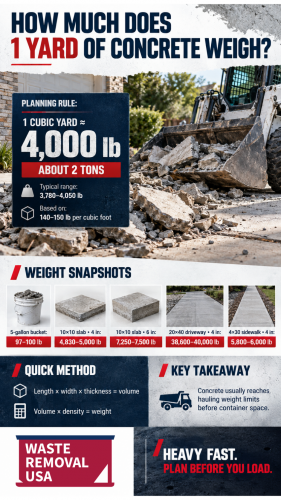
 For ordinary concrete, a useful range is:
3,780–4,050 pounds per cubic yard
That comes from a typical density of about 140–150 pounds per cubic foot.
Because:
1 cubic yard = 27 cubic feet
the calculations are:
27 × 140 = 3,780 pounds
and
27 × 150 = 4,050 pounds
For quick residential estimates, rounding to:
1 cubic yard of concrete ≈ 4,000 pounds
is generally practical.
However, engineers, concrete suppliers, haulers, and disposal providers may need a more precise value based on the actual material involved.
What Is the Unit Weight of Concrete?
Unit weight of concrete describes how much a specific volume of concrete weighs. It is commonly expressed in: pounds per cubic foot, or lb/ft³ ACI defines normalweight concrete as concrete with a density of approximately 150 lb/ft³. NRMCA gives a broader practical normalweight range of approximately: 140–150 lb/ft³ That means the density of the material—not simply its strength rating—is what determines how much a given volume weighs. For example:| Concrete Density | Approximate Weight per Cubic Yard |
| 140 lb/ft³ | 3,780 lb |
| 145 lb/ft³ | 3,915 lb |
| 150 lb/ft³ | 4,050 lb |
What Does “Dry Unit Weight of Concrete” Mean?
The phrase dry unit weight of concrete can cause confusion because it does not always mean the same thing as “old concrete that looks dry.” In technical concrete testing, density may be measured under different moisture conditions. Depending on the specification, that can include:- Fresh density
- Oven-dry density
- Equilibrium density
- Saturated density
How Much Does a Yard of Dry Concrete Weigh?
 A cubic yard of ordinary hardened normalweight concrete commonly remains around 3,800–4,050 pounds, depending on the mix and its actual moisture condition.
Using about 4,000 pounds per yard is usually reasonable for demolition and hauling estimates.
Do not assume that fully cured concrete becomes dramatically lighter simply because the original mixture contained water.
Concrete hardening involves hydration, where water reacts chemically with cement. Hardened concrete can also retain moisture in its pore structure.
As a result, the difference between fresh concrete and ordinary hardened concrete is generally much smaller than someone might expect from simply subtracting all of the original mixing water.
What Is Concrete Weight Per Yard When Wet?
Fresh normalweight concrete is also commonly near the same general range: about 3,800–4,050 pounds per cubic yard The exact concrete weight per yard wet should come from the actual mixture when precision matters. ASTM C138 is the standard test method used to determine the density of freshly mixed concrete. The National Ready Mixed Concrete Association also explains that ready-mixed concrete is sold by the volume of fresh concrete and that density is used to calculate the actual yield of a batch. For planning purposes, around 4,000 pounds per cubic yard remains useful. For quality control, formwork design, structural calculations, or disputes involving delivered quantity, use actual measured density rather than a generic estimate.Does Rain Make Demolition Concrete Much Heavier?
It can make it heavier, but the increase should not be exaggerated. Concrete is porous and can absorb water. Broken demolition concrete may also carry:- Wet soil
- Mud
- Sand
- Standing water between pieces
- Concrete porosity
- How saturated it becomes
- Amount of exposed surface
- Soil contamination
- Water trapped between debris
How Much Does a 5-Gallon Bucket of Concrete Weigh?
A five-gallon volume equals approximately 0.668 cubic foot. Using normalweight concrete at 145–150 lb/ft³: 0.668 × 145 = about 97 pounds 0.668 × 150 = about 100 pounds So a five-gallon bucket filled with normalweight concrete contains approximately: 97–100 pounds of concrete Add the weight of the bucket itself and the total may be around: 100–103 pounds depending on the bucket and concrete mix. That is also why carrying a truly full five-gallon bucket of concrete is generally impractical for one person. A partially filled bucket is much safer and easier to control.How Much Does Concrete Weigh Per Cubic Foot?
Normalweight concrete typically weighs about: 140–150 pounds per cubic foot A common midrange planning value is: 145 lb/ft³ At that density:- 1 cubic foot = 145 lb
- 5 cubic feet = 725 lb
- 10 cubic feet = 1,450 lb
- 27 cubic feet = 3,915 lb
How Much Does a Square Foot of Concrete Weigh?
You need the slab thickness. At approximately 145–150 lb/ft³:4-Inch Concrete Slab
One square foot weighs approximately: 48–50 pounds5-Inch Concrete Slab
One square foot weighs approximately: 60–63 pounds6-Inch Concrete Slab
One square foot weighs approximately: 73–75 pounds8-Inch Concrete Slab
One square foot weighs approximately: 97–100 pounds The relationship is linear. A slab twice as thick contains twice as much concrete per square foot.How Much Does a 10×10 Concrete Slab Weigh?
A 10-foot by 10-foot slab contains: 100 square feet If it is four inches thick, it contains about: 33.3 cubic feet or: 1.23 cubic yards Using 145–150 lb/ft³, the slab weighs approximately: 4,830–5,000 pounds At six inches thick, the same 10×10 slab contains: 50 cubic feet and weighs approximately: 7,250–7,500 pounds A two-inch difference in thickness adds well over a ton to this relatively small slab. That is why thickness is one of the most important measurements when estimating demolition weight.How Do You Calculate Concrete Weight?
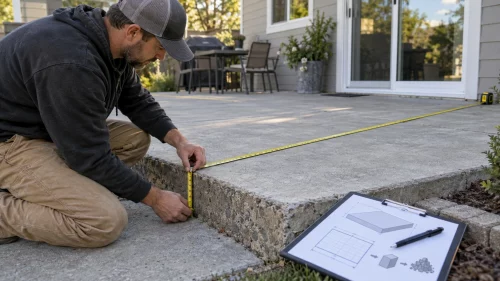 For a rectangular slab, use:
Length × Width × Thickness = Volume
Make sure the measurements are all in the same unit.
For dimensions measured in feet:
Length in feet × Width in feet × Thickness in feet = cubic feet
Then multiply by concrete density:
Cubic feet × pounds per cubic foot = total pounds
Example
Suppose a patio measures: 12 feet × 16 feet × 4 inches thick Convert four inches to feet: 4 ÷ 12 = 0.333 feet Calculate volume: 12 × 16 × 0.333 ≈ 64 cubic feet At 145 lb/ft³: 64 × 145 ≈ 9,280 pounds That is roughly: 4.6 tons The patio contains only about: 2.37 cubic yards yet weighs close to five tons.How Do You Convert Cubic Feet Into Cubic Yards?
Divide cubic feet by: 27 because: 1 cubic yard = 27 cubic feet Using the 64-cubic-foot patio example: 64 ÷ 27 ≈ 2.37 cubic yards Then multiply by the estimated weight per cubic yard: 2.37 × 3,915 ≈ 9,280 pounds You can reach essentially the same result using either method. Waste Removal USA’s weight calculators can also provide a quick baseline for planning projects involving dense construction materials.Does Concrete PSI Determine Its Weight?
Not directly. PSI measures compressive strength. Density measures mass or weight per unit volume. Two concrete mixes can both achieve similar compressive strength while having different densities. Likewise, higher-strength concrete is not automatically much heavier. Weight can vary because of:- Aggregate type
- Air content
- Mix proportions
- Lightweight aggregate
- Heavyweight aggregate
Does Reinforced Concrete Weigh More?
Yes, because steel reinforcement adds weight. Reinforcement may include:- Rebar
- Welded wire reinforcement
- Anchors
- Embedded steel
- Footing
- Wall
- Structural slab
- Bridge element
Does Broken Concrete Weigh More Than Solid Concrete?
Breaking concrete does not make the actual concrete material heavier. One cubic yard of solid concrete volume still contains roughly the same mass after demolition. What changes is the bulk volume. Broken chunks leave air spaces between pieces, so: one cubic yard of loose broken concrete in a container is not the same thing as one cubic yard of solid slab before demolition. This distinction is extremely important. If a solid slab contains two cubic yards of concrete, breaking it apart may occupy more than two cubic yards of container space because of voids between irregular chunks. The total concrete weight remains essentially unchanged unless:- Dirt is mixed in
- Water is added
- Other debris is included
- Material is left behind
Does Soil Contamination Increase Concrete Load Weight?
Yes. Concrete removed from:- Footings
- Foundations
- Buried pads
- Old driveways
- Concrete
- Rebar
- Dirt
- Gravel
- Mud
Can Concrete Be Recycled?
Often, yes. EPA identifies concrete as a highly recoverable construction and demolition material where local markets exist. It can be processed into aggregate and used in applications such as subbase and other approved construction uses. Acceptance requirements vary. Facilities may distinguish among:- Clean concrete
- Concrete with rebar
- Painted concrete
- Concrete mixed with soil
- Concrete mixed with brick or asphalt
Why Does Concrete Weight Matter for Removal?
Concrete creates three major logistical challenges.Transportation
Several cubic yards can put many thousands of pounds onto a truck or trailer. Vehicles have legal and mechanical weight limits.Manual Handling
Even small pieces become heavy. At 150 lb/ft³, a block measuring: 12 × 12 × 6 inches contains half a cubic foot and weighs about: 75 pounds Breaking slabs into smaller pieces can reduce lifting risk.Disposal
Concrete can reach a hauling weight limit long before available container volume is used. That makes estimating total tonnage before demolition particularly important.Why Does Concrete Usually Need Its Own Cleanup Plan?
Concrete is much denser than ordinary renovation debris. For example, just: 2 cubic yards of solid normalweight concrete can weigh approximately: 7,560–8,100 pounds or close to four tons. That is why concrete is often managed separately from lighter materials such as:- Drywall
- Packaging
- Trim
- Light wood debris
Why Isn’t a Bigger Container Always Better for Concrete?
 Container volume and legal hauling capacity are two different things.
A large container may physically hold many cubic yards of broken concrete, but filling it completely could create an unsafe or untransportable load.
That is why dense materials are often placed in smaller-capacity containers.
A 10-yard cleanup container may be appropriate for some concrete projects, but the fact that the container has 10 cubic yards of physical volume does not mean it can safely be filled with 10 solid cubic yards of concrete.
Ten cubic yards of ordinary solid concrete could weigh approximately:
37,800–40,500 pounds
before accounting for other material.
Always follow the provider’s specific fill and weight requirements.
How Do You Estimate a Driveway’s Concrete Weight?
Measure:- Length
- Width
- Average thickness
- Thicker edges
- Uneven depth
- Reinforcement
- Repairs
- Attached curbs
How Do You Estimate a Sidewalk’s Concrete Weight?
Suppose a sidewalk is: 4 feet wide × 30 feet long × 4 inches thick Volume: 4 × 30 × 0.333 ≈ 40 cubic feet Estimated weight: At 145 lb/ft³: about 5,800 pounds At 150 lb/ft³: about 6,000 pounds A relatively modest sidewalk can therefore weigh around three tons. This is why visual size is a poor way to estimate concrete removal difficulty.What About Lightweight Concrete?
Not all concrete weighs close to 150 lb/ft³. NRMCA describes structural lightweight concrete as having an equilibrium density of approximately: 90–120 lb/ft³ That equals: 2,430–3,240 pounds per cubic yard Lightweight concrete uses lightweight aggregate to reduce density while still providing required structural performance. If you know the material is lightweight concrete, using the standard 4,000-pound estimate can substantially overstate its weight.Can Concrete Be Heavier Than 4,050 Pounds Per Yard?
Yes. Special heavyweight concrete uses dense aggregates and can weigh considerably more than ordinary normalweight material. These mixes may be used for:- Radiation shielding
- Specialized industrial structures
- Counterweights